The World's Strangest Casino Games
Last updated: 15 September 2026
Mention casino games and most people immediately think of slots, blackjack, roulette, baccarat, and perhaps poker. But the gambling world has always had a much stranger side. Across different countries, cultures, and eras, casinos have embraced games that look unfamiliar, sound improbable, or feel completely unlike the standard table and reel formats most players know today.
Some of these unusual games are long-established classics outside the Western mainstream. Others are modern inventions that blur the line between arcade play, game shows, instant-win formats, and traditional gambling. A few are simply strange because of how they present risk, pace, or player interaction.
In this guide, we explore some of the world's strangest casino games, explain what makes them unusual, and look at why players are often drawn to games that sit well outside the usual slots-and-roulette comfort zone.
Quick Picks: Casinos With Strong Game Variety
Casino Beacon Opinion
The most interesting unusual casino games are the ones that genuinely change how gambling feels, rather than simply putting a novelty skin over familiar mechanics. Fan-Tan is perhaps the standout example here, while Pachinko, Chuck-a-Luck and modern crash games each approach chance, anticipation and player involvement in noticeably different ways.
Not every obscure game deserves rediscovery, but stepping outside the usual slots, blackjack and roulette line-up can be surprisingly entertaining. The appeal is less about finding a 'better' game and more about discovering just how inventive - and occasionally downright weird - gambling can be.
Recommended Online Casinos for Players Who Like Variety
If unusual casino games appeal to you, choosing a casino with a broad and varied game library gives you a much better chance of finding something genuinely different. The casinos below all offer much more than traditional slots and table games, making them ideal if you enjoy discovering new formats and niche titles.

Sloto'Cash Casino
Best for: broad classic casino variety with slots, video poker, table games, keno, specialty games, and live dealer options.
Good fit for players who enjoy moving beyond standard slot sessions into blackjack, roulette, poker-style formats, and a wider traditional game mix. Exclusive $31 free no deposit bonus and long-established reputation.
Play Now - See Review
SunnySpins Casino
Best for: players who like mixing mainstream and less familiar formats.
Offers a large RTG/SpinLogic catalogue, video poker, table games, and live dealer play. The range makes it a good place to branch out from simple reels into more varied gambling formats. Includes a $55 free bonus and same day withdrawals.
Play Now - See Review
Lucky Elf Casino
Best for: huge game range, including 13,000+ slots and an enormous live dealer collection.
If you enjoy discovering formats outside the norm, Lucky Elf's scale makes it easier to explore niche styles, variants, and modern hybrid titles. Exclusive for Australia, Austria, Canada, Denmark, Finland, Germany, Ireland, New Zealand, Norway and Switzerland.
Play Now - See Review
Decode Casino
Best for: trying different providers without overcomplicating the experience. Easy-to-use lobby.
Multi-software catalogue with slots and table formats from several providers, making it a good place for players who want variety and easy experimentation. Includes a 10 free spins no deposit bonus at sign-up.
Play Now - See ReviewIf you enjoy exploring unfamiliar formats, you may also want to browse our guides to live dealer casinos and scratch cards.
The games below come from very different eras and gambling cultures. Some were once major casino attractions, while others still look unusual even by modern online casino standards.
- Traditional Asian games: Fan-Tan and Sic Bo
- Japanese gambling culture: Pachinko
- Unusual dice games: Chuck-a-Luck and Crown and Anchor
- Forgotten casino games: Red Dog, Boule and Faro
- Modern oddities: crash games and live casino game shows
What Makes a Casino Game Strange?
A strange casino game is not necessarily a bad one, nor even a very obscure one. Usually, a game feels unusual for one of four reasons:
- it comes from a gambling tradition many players are unfamiliar with
- it mixes mechanics from outside the standard casino world
- it uses a presentation style that feels more like a show, arcade, or novelty format
- it creates a very different emotional rhythm from classic casino staples
Sometimes 'strange' just means culturally unfamiliar. A game that seems exotic in one market may be completely normal in another. In other cases, the game really is unusual because it barely resembles the formats most people associate with casino gambling.
That is part of the appeal. Strange casino games remind players that gambling is not a fixed set of products. It evolves constantly, borrowing ideas from local traditions, entertainment trends, and new technology.
The World's Strangest Casino Games
1. Fan-Tan
Fan-Tan may be one of the strangest gambling games ever devised, largely because its central mechanic is so wonderfully simple. A dealer takes a pile of small counters, traditionally coins, beans or similar objects, separates a random quantity and then removes them four at a time until only one, two, three or four remain.
Players bet on what that final remainder will be. That's essentially the game. There are no cards to read, reels to spin or complicated combinations to recognise - just a mysterious pile of objects gradually being reduced in groups of four. Fan-Tan has deep roots in Chinese gambling culture and became particularly associated with gambling houses in Macau.
2. Pachinko
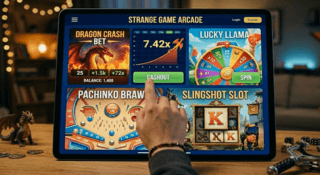
Pachinko looks more like an arcade machine crossed with vertical pinball than anything most players would recognise as a conventional casino game. Players fire small metal balls into a densely packed upright playfield, where they bounce unpredictably through pins and obstacles before either disappearing or triggering further play.
At a glance, pachinko can easily be confused with Plinko because both involve objects bouncing through a field of pins or pegs. They are very different games, however. Plinko typically involves dropping a single ball or disc through a pegboard towards prize or multiplier positions, while pachinko uses many small metal balls fired into a much more elaborate vertical machine.
Pachinko occupies its own distinctive place in Japanese gambling and amusement culture, rather than being a normal casino table game. That makes it particularly interesting here: it demonstrates just how different gambling can look when it develops outside the familiar world of reels, cards and roulette wheels.
3. Chuck-a-Luck
Chuck-a-Luck takes three ordinary dice and puts them inside an hourglass-shaped cage that can be rotated end over end. The cage has helped give the game its memorable 'birdcage' nickname, and watching three dice tumble around inside it immediately makes Chuck-a-Luck look more like a fairground attraction than a modern casino table.
Players wager on the numbers that will appear when the dice settle. The basic idea is simple, but the strange contraption used to roll the dice gives the game most of its character. Chuck-a-Luck is closely related to other three-dice gambling games, including Sic Bo, but visually it is difficult to mistake for anything else.
4. Crown and Anchor
Crown and Anchor takes the basic three-dice idea in another direction. Instead of ordinary numbers, each die carries six symbols: a crown, an anchor, a heart, a diamond, a club and a spade. Players place their bets on those symbols before all three dice are thrown.
The game has a particularly strong association with British naval, merchant and fishing communities. Mechanically it is closely related to Chuck-a-Luck, but replacing numbers with crowns, anchors and playing-card suits gives it an unmistakable identity. It is the sort of old gambling game that sounds fictional until you discover people really did play it.
5. Sic Bo
Sic Bo is considerably more established in modern casinos than some of the games on this list, but it can still look baffling to somebody encountering it for the first time. Three dice determine the result, while the betting layout can contain wagers covering totals, individual numbers, doubles, triples and specific combinations.
The strange part is the contrast between the simplicity of rolling three dice and the visual complexity of everything surrounding them. Once the layout makes sense, Sic Bo becomes much less intimidating, but its distinctive structure still feels very different from familiar Western casino staples.
6. Red Dog
Red Dog sounds as though it ought to involve racing greyhounds or a Wild West saloon. Instead, the casino version is an unusually simple card game built around the numerical gap between two cards.
Two cards are dealt face up and, when there is a gap between their ranks, a third card is drawn. The key question is whether that third card will land between the first two. The number of possible ranks between them is known as the 'spread', with the payout changing according to its size. It is an oddly specific premise for an entire casino game, which is precisely why Red Dog earns a place here.
7. Boule
Boule looks as though somebody decided roulette was unnecessarily complicated and stripped it down to the bare essentials. Instead of the familiar roulette sequence, Boule uses only the numbers 1 to 9 on a large wheel, together with black, red and yellow outcomes.
A rubber ball is spun around the wheel and eventually settles into the winning position. Number 5 is particularly distinctive because it is yellow rather than red or black. The result is recognisably related to roulette while looking just unfamiliar enough to make an experienced casino player wonder what on earth has happened to the wheel.
8. Crash Games
Crash games are among the strangest modern additions to online gambling because they dispense with most traditional casino imagery. A multiplier begins to rise and continues climbing until the game suddenly crashes. Players who cash out beforehand keep the value shown at that moment - anyone still waiting when the crash occurs loses the bet.
The mechanic is remarkably sparse, but that simplicity creates the tension. There are no card hands to interpret or reels to watch - just the decision of whether to take the current multiplier or risk waiting a little longer. See our Crash Games Guide for a closer look at how the format works.
9. Faro
Faro was once a major gambling game but would look decidedly unfamiliar on a modern casino floor. A traditional table displays the 13 card ranks from ace through king, allowing players to place bets on the ranks they think will win.
The banker then deals cards in pairs, with one rank losing and the other winning. Faro originated in France and later became enormously popular in 19th-century America before virtually disappearing from casinos. Its former popularity makes its obscurity today particularly strange - this isn't some forgotten experimental game, but a once-famous one that largely vanished.
10. Casino Game Shows
If Fan-Tan represents gambling's strange past, live casino game shows demonstrate just how strange its present can be. Giant wheels, presenters, bonus rounds, oversized props and brightly lit studios can make the experience look more like Saturday-night television than a casino table.
That is deliberate. Game shows blur the boundary between gambling and entertainment, replacing the relatively restrained atmosphere of traditional table games with spectacle and personality. They may now be a familiar sight at online casinos, but step back for a moment and the concept remains wonderfully odd: a television-style game show being broadcast live so viewers can gamble on what happens next.
Why Players Love Unusual Casino Games
Players are often drawn to strange casino games for the same reason people enjoy unusual food, niche sports, or cult films: they offer novelty without abandoning the core thrill. You still get uncertainty, anticipation, and the possibility of reward - just delivered in a less familiar wrapper.
Unusual games can also feel refreshing because they interrupt player habits. If you are tired of endless slot sessions or the standard rhythm of blackjack and roulette, an unfamiliar format can make the whole casino experience feel new again.
- they create curiosity
- they offer a different emotional pace
- they can feel more playful or theatrical
- they often attract players who enjoy experimentation
- they make the casino world feel broader and less repetitive
In short, unusual games appeal because they remind players there is more than one way to gamble.
Are Strange Casino Games Worth Playing?
Sometimes yes, sometimes no - and that depends less on how weird the game looks than on whether it fits your taste. An unusual game is worth trying if its style genuinely interests you, its rules are understandable, and the pace suits the kind of session you want.
The danger is assuming that novelty automatically means value. Some unusual formats are fascinating but not necessarily something you will want to return to regularly. Others look odd at first and then become surprisingly enjoyable once you understand them.
A sensible approach is:
- learn the basic rules first
- check whether the game is luck-heavy or involves choices
- keep stakes low while you experiment
- treat novelty as entertainment, not evidence of better value
If you want a more practical foundation before experimenting, see our guides to real money casino tips and Luck vs Skill in Casino Games.
Strange Casino Games FAQ
Unusual casino games often raise questions because they don't follow the familiar patterns of slots, roulette or blackjack. Here are answers to some of the most common questions about strange casino games, how they work and whether they're worth trying.
What is the strangest casino game in the world?
That depends on your frame of reference, but Fan-Tan is a strong contender. Players bet on how many objects will remain after a dealer repeatedly removes them in groups of four. Pachinko, Chuck-a-Luck, Crown and Anchor and modern crash games are also very different from conventional casino formats.
Are unusual casino games real casino games?
Yes, many are. Some are traditional in certain regions, while others are newer formats that stretch what players normally expect from casino gambling.
Why do strange casino games appeal to players?
They offer novelty, curiosity, a different emotional pace, and a break from the standard slot-and-table routine.
Are unusual casino games harder to understand?
Sometimes, but not always. Some strange-looking games are actually quite simple once you learn the basic structure.
Are strange casino games better value than normal ones?
Not automatically. A game's value depends on its rules, RTP or edge structure, and volatility - not on how unusual it looks.
Should beginners try unusual casino games?
Yes, if they are curious - but it makes sense to start small, learn the rules, and treat the first few sessions as exploration rather than serious play.