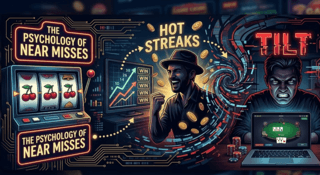
The Psychology of Near Misses, Hot Streaks, and Tilt
Last updated: 07 September 2026
Gambling can make random events feel surprisingly meaningful. A near miss can feel as though a win was almost within reach. Several wins close together can become a hot streak that seems too convincing to be coincidence. And after a frustrating loss, tilt can make a decision that would have seemed unreasonable half an hour earlier suddenly feel perfectly sensible.
What makes these experiences interesting is that knowing the odds does not necessarily make the feelings disappear. Someone can understand perfectly well that the next spin, hand, or roulette result is not being influenced by what just happened and still feel that a game is "due", that a winning run has momentum, or that one more bet could put the session right.
This guide looks at why those reactions are so persuasive, how memory and pattern-seeking can make randomness feel less random, and what happens when emotion begins changing the way a player makes decisions.
Quick Picks: Recommended Online Casinos
Casino Beacon Opinion
Near misses, winning streaks, and tilt are powerful because they can change what a random event seems to mean. A player may understand the probability perfectly well and still feel that a win is "getting closer", that a streak has momentum, or that another bet could repair a disappointing session.
The important distinction is between experiencing those reactions and allowing them to quietly rewrite a decision. Enjoying a winning streak is not the same as assuming it will continue. Feeling frustrated by a loss is not the same as deciding it must be recovered. And noticing a near miss does not require treating it as information about what happens next.
Randomness can produce extraordinary sequences, memorable near misses, and nights when everything seems to go right or wrong. What it cannot do is remember what happened before.
Recommended Online Casinos

Sloto'Cash Casino
Best for: online casino newcomers looking for a friendly, entry-level venue. High rollers welcome too.
Wide selection of SpinLogic/RTG slots, video poker and table games, plus ViG live dealers. Solid mobile UX, exclusive $31 free no deposit bonus for new sign-ups, plus $7,777 welcome promos. Rapid withdrawals and solid player support. Online since 2007.
Play Now - See Review
Winz Casino
Best for: serious slots, video poker and table games fans chasing high RTP tables and instant cashouts around-the-clock.
More than 9000 games from dozens of providers, loads of video poker variants and live dealer tables, with zero wagering on ALL bonuses.
Play Now - See Review
SunnySpins Casino
Best for: bonus hunters and serious players wanting a full suite of SpinLogic/RTG games + live ViG.
Quality international online casino welcoming new members with a generous $55 free bonus, no deposit required, plus a 150% 'All Games' bonus up to $250. Same-day, unlimited cashouts add to the appeal.
Play Now - See Review
Lucky Elf Casino
Best for: 13,000+ slots, largest live dealer table games collection, plus instant payouts.
Huge selection of blackjack variants, baccarat, and video poker. Up to $/€8,000 bonus + 350 free spins. Exclusive for Australia, Austria, Canada, Denmark, Finland, Germany, Ireland, New Zealand, Norway, and Switzerland.
Play Now - See ReviewFor more practical advice on choosing casinos, managing a session, and avoiding common mistakes, see our Real Money Casino Tips and Online Casino Dos and Don'ts guides.
What Near Misses, Hot Streaks, and Tilt Actually Mean
Near misses, hot streaks, and tilt describe three different experiences, but they have something important in common: each can change the way the next gambling decision feels.
A near miss is a loss that feels unusually close to being a win - perhaps the jackpot symbol that stops one position away, or the blackjack hand that misses by the narrowest margin. Nothing has been won, but the result can feel very different from an ordinary loss because success seemed almost within reach.
A hot streak is different because something genuinely has happened: several wins have arrived close together. The questionable part is not recognising the streak, but deciding what it means. A run of wins can make someone feel unusually lucky, confident, or tempted to believe that whatever has just been happening is likely to continue.
Tilt describes the change that can happen when emotion begins influencing decisions. Frustration is one route into it, but so are impatience, desperation and even excitement or overconfidence. A player does not need to be furious or visibly out of control to start making decisions differently.
These experiences can also overlap. A near miss can encourage another attempt. A run of wins can make a larger bet feel easier to justify. A sudden reversal can turn confidence into frustration. The interesting part is not simply what happened in the game, but how quickly what happened can change what feels reasonable to do next.
Why Near Misses Feel So Powerful
A near miss can feel oddly energising. Think of two jackpot symbols landing on a slot reel, only for the third to stop just above the line. Or losing a blackjack hand by a narrow margin after feeling ahead. Logically, a near miss is still just a loss. Emotionally, though, it can feel as though success was almost within reach.
Part of the reason is that the brain does not treat every losing outcome equally. An ordinary loss is easy to dismiss because nothing memorable happened. A near miss creates anticipation, disappointment, and a sense of unfinished business all at once. That combination can make the result feel more significant than a routine loss, even though the odds have not changed.
That is where players can get into trouble. A near miss can create a false sense of momentum, especially in games like slots, where visual design and anticipation are a big part of the experience. If you're interested in how slot structure shapes player experience, see our guides to slot volatility and how to compare online slot games.
This effect is especially strong in highly visual games. Flashing reels, bonus teases, dramatic sounds, and delayed stopping animations can make a near miss feel personal. Players may come away thinking, "That machine nearly paid," or "I was just one symbol away." But in random games, closeness does not carry over into the next round.
Near misses can also encourage chasing. Not always in a dramatic way - sometimes just in the form of a few extra spins, one extra deposit, or a small increase in bet size. That is often how emotional drift begins: not with one outrageous decision, but with a series of small choices that feel justified in the moment.
Why Hot Streaks Feel Real
Hot streaks are interesting because, unlike near misses, the streak itself is not necessarily an illusion. If you win several rounds in a row, you really have had a winning streak. The psychological trap is assuming that the recent run tells you something reliable about what will happen next.
Human brains are natural pattern-spotters. Put several wins together and they quickly start to look connected rather than coincidental. A player might feel unusually lucky, think they have found the right game at the right time, or simply feel that everything is clicking. That feeling can be convincing even when randomness is doing all the work. Our casino myths and Luck vs Skill guides look at some of the same thinking from different angles.
Winning also changes how decisions feel. A bet that seemed too large half an hour ago may suddenly seem reasonable when you are ahead. Extending the session can feel less risky because you are "playing with winnings". And a decision followed by a win is very easy to remember as a good decision, even when the result depended mostly or entirely on chance.
That confidence can gradually change the way someone plays. A player who normally keeps stakes steady might increase them. A cautious slots player might move towards higher-volatility games. Someone who intended to stop at a particular time might carry on simply because walking away during a good run feels wrong.
There is nothing strange about enjoying a winning streak. The useful distinction is between enjoying what has already happened and treating it as evidence about what happens next. In games where each result is independent, recent wins do not make the next one more likely.
What Tilt Is and How It Starts
Tilt is the point where emotion starts influencing decisions more than it normally would. The term is often associated with anger, but tilt does not have to look dramatic. It can show up as frustration, impatience, stubbornness, desperation, or even overconfidence after a good run.
What makes tilt interesting is that it often has a trigger. A painful near miss can create frustration. A sudden loss after a winning streak can feel like something has been taken away. A series of smaller losses can gradually make a player more impatient. The emotional response is different in each case, but the effect can be similar: decisions that seemed unreasonable at the start of the session begin to feel perfectly justified.
That might mean increasing a stake to recover a loss, making another deposit because stopping while behind feels unsatisfying, or simply continuing to play for much longer than intended. None of those decisions necessarily feels reckless in the moment. Tilt has a way of providing its own explanation for why the next bet, spin, or deposit makes sense.
This is why tilt can be difficult to recognise from the inside. It can feel less like losing control and more like determination: "I'll stop when I get some of that back," or "one decent win will turn this around." After a winning streak, the same effect can work in the opposite direction, with confidence making bigger bets or a longer session feel easier to justify.
Feeling annoyed by a loss or excited by a win is not tilt by itself. The more useful question is whether that emotion has started changing decisions. If the amount being bet, the time being spent, or the limits set before playing begin to move because of what just happened, emotion may have started steering the session.
Why Randomness Feels Personal
True randomness rarely looks as random as people expect. We tend to imagine a random sequence as nicely mixed: a win here, a loss there, perhaps a short streak occasionally. Real random results can be much messier. Wins can bunch together. Losses can keep arriving. The same type of result can appear several times in succession for no particular reason at all.
When that happens, the brain naturally looks for an explanation. A slot starts to feel "due". A run of wins feels as though it has momentum. A roulette table can seem unusually favourable or hostile. After a near miss, the next attempt can somehow feel more promising. Random events begin to acquire a story.
Two opposite beliefs can even appear depending on the situation. After a long run of losses, someone might think a win must be getting closer because the results should eventually balance out. After a run of wins, the same person might feel that the streak is likely to continue. One expects the pattern to reverse, the other expects it to persist - but both are attempts to use recent results to make an uncertain next result feel more predictable.
Memory adds another layer. A dramatic near miss is easier to remember than an ordinary losing spin. A big win is more memorable than dozens of uneventful rounds. An extraordinary streak can stay in someone's mind for years, while all the sessions in which nothing remarkable happened gradually blur together. Looking backwards, gambling history can therefore appear more full of patterns than it felt while it was actually happening.
There is also something uncomfortable about accepting that an outcome may have no message in it at all. If a game is "cold", there is something to respond to. If a machine is "due", there is a reason to stay. If you are "on a roll", there is a reason not to leave. Pure uncertainty offers none of that. It gives the player no hidden signal to discover and no pattern to act upon.
This does not mean every casino decision is meaningless or that skill never matters. Different games involve very different levels of player choice. But where an outcome is random, randomness does not know what happened to you five minutes ago. It does not know that you nearly won, that you have been losing all evening, or that tonight feels unusually lucky. For a clearer look at the mathematics behind casino games, see our guide to house edge, RTP, and volatility.
When Emotion Starts Changing the Way You Play
One of the difficulties with gambling emotions is that the change in behaviour can be gradual. There may be no obvious moment when a relaxed session becomes an impulsive one. Instead, small decisions begin to shift.
Stakes might creep upwards after a near miss or a run of losses. A planned stopping time becomes flexible. Another deposit starts to feel reasonable. Someone who normally plays one or two familiar games may begin jumping between them, looking for something that will change the direction of the session.
Pace can change too. Bets are placed more quickly, balances are checked less carefully, and there is less time between one result and the next decision. None of these behaviours proves that someone has lost control. What matters is whether they represent a change from how that person intended to play when the session began.
Motivation can shift as well. Playing because a game is enjoyable is different from playing because leaving now would feel unbearable, because a loss needs to be recovered, or because a winning streak feels too valuable to abandon. From the player's perspective, those changes can be surprisingly easy to miss because each individual decision still has an explanation.
A useful comparison is not with somebody else's gambling, but with your own intentions at the start of the session. If the budget, stakes, stopping point, pace, or reason for continuing have all begun to move, that tells you more than any single bet does.
Making Decisions Before Emotion Makes Them for You
There is a simple reason so much gambling advice involves setting limits in advance: the person deciding how much to spend before a session may not think quite like the person who has just experienced a big win, a painful loss, or three tantalising near misses in a row.
A budget, a stopping time, or a maximum stake is really a decision made by your calmer self for your more emotional self. The point is not that the original limit is somehow perfect. It is that changing it halfway through a session deserves more scrutiny when the reason for changing it is whatever just happened.
Small barriers can help with that. Someone might decide not to redeposit during the same session, not to increase a stake immediately after a loss, or to take a break before deciding what to do after a big win. Slots players may also find our slots bankroll management guide useful for thinking about stakes and session budgets.
Breaks matter for a similar reason. They interrupt the chain between an emotional result and the decision that follows it. Even a short gap can turn "I need another spin" into the rather different question of whether another spin is actually what you want.
None of this requires treating every gambling session like a military operation. Plans can change. People can decide to play longer, spend less, spend more within what they can comfortably afford, or simply go home while they are having a good night. The useful part is noticing whether the decision is genuinely being reconsidered or merely being justified after the emotion has already made it.
If gambling repeatedly becomes stressful, difficult to stop, or harder to keep within limits than intended, our Responsible Gambling & Addiction Advice page covers support options and practical next steps.
Casino Psychology FAQ
What is a near miss in gambling?
A near miss is a losing result that feels unusually close to a win. It might be a jackpot symbol stopping one position away or a narrowly lost hand. The important distinction is that the feeling of being close can be powerful even when it does not change the odds of what happens next.
Are hot streaks real?
Yes - in the sense that several wins really can occur close together. What a hot streak cannot reliably tell you is what happens next. In games with independent random outcomes, a run of recent wins does not make another win more likely.
What does tilt mean?
Tilt is when emotion begins changing the way someone makes gambling decisions. It is often associated with frustration or anger, but impatience, desperation, excitement and overconfidence can influence decisions too.
Why do near misses make people want to keep playing?
A near miss can create anticipation, disappointment and a sense of unfinished business at the same time. Because the result feels different from an ordinary loss, another attempt can feel unusually tempting even though the near miss itself has not made a future win more likely.
How can I tell if emotion is changing the way I play?
Compare the decisions being made now with the intentions you had before playing. Changes in stakes, spending, pace, stopping time or the reason for continuing can be more revealing than trying to decide whether you feel "on tilt".
Why is it useful to set gambling limits in advance?
Limits create a reference point decided before a big win, frustrating loss or near miss changes how the situation feels. They do not make every later change automatically wrong, but they make it easier to notice when emotion may be influencing a decision.